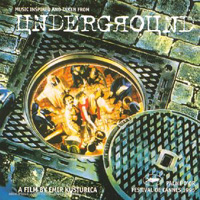
Underground


|
Underground |
|
 |

Original Title : Bila jednom jedna zemlja (1995)
|
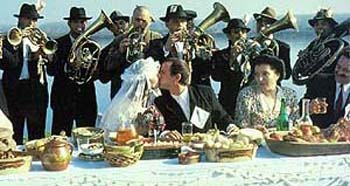
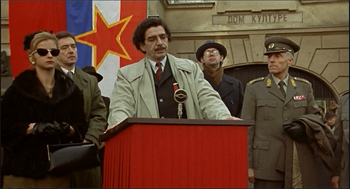
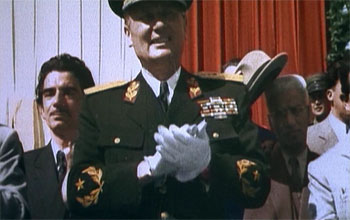
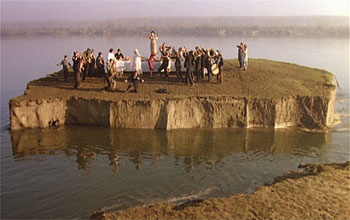
1941. Belgrade. Marko, communist activist let his friend Blacky enter the Party. But German invade Yugoslavia and the two friends will share their time between acts of resistance and very profitable traffics. They will share also beautiful Natalja, an actress whom a Nazi officer "protects". During the conflit, Marko will arrange to lock up Blacky and its clan in the basement of an house of Belgrade. Thus will he be able to keep Natalja for himself only. In 1945, he will voluntarily silence the people of the basement who manufacture weapons for Resistance that the country was free. He will continue to exploit them during decades, for his greater profit. But one day, the slaves will leave the basement and will find their country devastated by the civil war...
Casting :
If you search the soundtrack : Original Motion picture Soundtrack CD of Underground on Amazon.fr, Amazon.com, Amazon.co.uk, or Amazon.de
A DVD of very beautiful quality, containing very interesting bonus. The glance which Emir carries on his film is lucid. He does not hesitate to bring it closer to the events which upset the world today.
The comparison of this DVD with the Belgian edition is useless : no 5.1 soundtrack, no real bonus (except an interview as conventional as it is short), no interactivity. Moreover, the simultaneous comparison of the video tracks gives a more saturated and slightly less clear image.
A complete comparison of both DVDs is visible on DVDBeaver website.
If you want to buy this DVD : DVD Underground on Amazon.com (zone 1) or DVD Underground on Amazon.co.uk (zone 1)
Presentation of film by Serge Grünberg: "Underground", the last film of Emir Kusturica, is already a legend. It is not only because it won the Golden Palm of the last festival of Cannes. There has been many lines written about the uncommon length of his shooting, on the exceptional means that CIBY 2000 put together to allow the making of a fresco which embraces a period of fifty years and the visionary genius of its author. But in a certain way, "Underground" succeeded in creating a new kind: a baroque, burlesque and musical epic on one of the greatest tragedies of the modern era: the Yugoslav crisis. Far from propaganda for any side, far from any official and edifying art, very far from hagiography or historical films, "Underground" calls the major sources of the world cinema, from Vigo to Kubrick, Lubitsch to Visconti, to tell us the story of a country ! And this country, as each one knows, from now on, is a country which doesn't exist any more; an idea, a dream killed by human passions.
Emir Kusturica : "Man manages to find the force to survive, even in the worst circumstances... "
Davor Dujmović has played in three films of Emir Kusturica. He committed suicide in 1999.
There is a 75 mn making-of (compared to the poor five little minutes on the DVD), directed by Aleksandar Manić (czec director). This making-of was broadcast in january 2003 on CanalSatellite in French. It shows many unknown scenes, gives a deep analysis of the movie themes, and its relationships with the events of 1995.
A few keys to help understand the symbols in Underground.
There is a long version of this film (5h), broadcast in episodes both on Yugoslav and French television, then commercialised by TF1 video in double VHS tapes sets.
Underground is certainly the best illustration to what represents cinema for Emir Kusturica : it must be " bigger than life."
 >>> watch the trailer (with French subtitles)
DVD, VHS
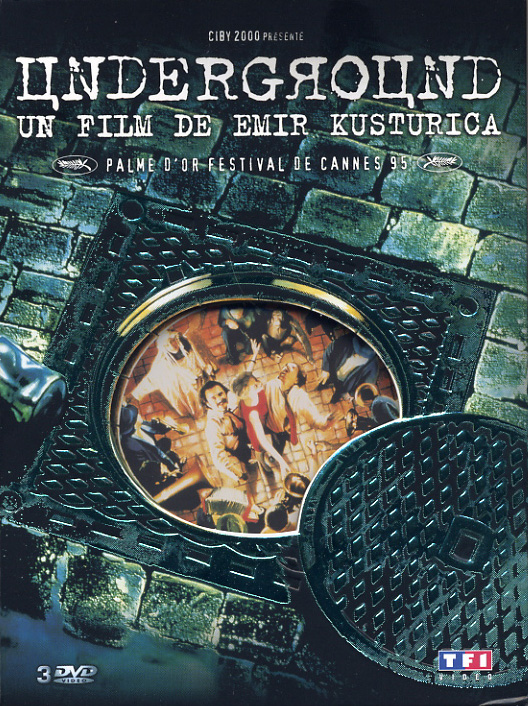
The TF1 video collector 3 DVD set

Released : 22 april 2005
Languages : Serbian (Dolby Digital 5.1 & dts 5.1), French (Dolby Digital 5.1 & dts 5.1)
Subtitles : French
Bonus :
 This collector set is available on Amazon.fr.
The picture and sound quality are absolutely incredible : completely remastered for the release, each of both DVD proposes the film with a dts 5.1 soundtrack (in original or in French language). "dts" sound is amazing : the brass bands, the bombs, the animals seem to be in the room : we're in the middle of a zoon, we're in the cave, we're inside the film...
The Belgian DVD (zone 2) :

Released : March 2003
Languages : Serbian (2.0 & 5.1), French
Subtitles : French, Dutch
Bonus :
This DVD is distributed by cinéart, for Belium, and is available online on DVD zone 2.
The American New Yorker DVD (zone 1) :
Release : December 2003
Languages : Serbian (2.0)
Subtitles : English
Bonus :
Anecdotes :
Critics :
 "Heteroclite, cocasse and lyric "
This oversizing is present at every level : in the length of the story told, in the complexity and ambiguity of the characters, the over-reacted comments in the press at its release.
But let's go back to 1995 : at the beginning of the year, tension is at its maximum on the set ; after two years of hard working where Emir Kusturica rewrites the script day after day, provokes the tension between the actors in order to let them explode in front of (or even behind) the camera, piles the delays, the technical problems and the money spent. Nobody knows if the film will be ready for the Festival of Cannes ; only the director seems to believe in it. Rumours spread until the day before the festival, but finally the film is projected. The public is astonished by a film that crosses the decades to come up to the images we saw yesterday on TV. We must remember indeed that war was raging with a rare intensity throughout all ex-Yugoslavia since 1992, and even if Bosnia was torn apart, it resisted and even won battles on the serbian front. In this atmosphere where no camp seemed to be more offensor than offended, the film wins the Palme D'Or on may 22nd 1995, by the jury, headed by Jeanne Moreau.
But three days later with the massacre of 72 young Bosnians in Tuzla, then the one of Srebrenica in July, the public opinion definitively considers the Serbians as the sole responsible of all the disasters of the war. Controversy on the film will raise with the insulting article of Alain Finkielkraut in French newspaper Le Monde where he claims Emir Kusturica serves the pro-serbian cause of Milošević. Is it necessary to recall that Alain Finkielkraut hadn't seen the film ? This polemic will be followed by a lot of articles in the press where the pro-Kusturica and anti-Kusturica French "intellectuals" will fight, each one using mostly the same arguments. Nobody criticises the baroque, epic and tragi-comic aspect of the film, and we end in considering insignificant details, forgetting to consider the film with the necessary distance. The film will be be a success in the theatres, and the whole affair will strongly affect the director to the point he claims he wants to stop making movies... He turns then toward music for a few years with his group the No Smoking Orchestra.
Today, with a 10 years distance on these events, we can only but applause the vision of the film. It is more evident than ever that the film takes place higher than the tragedies, and that the main message is a denounciation of any form of propaganda : whether the one of the Tito utopist communist apparatus or the one of the western media that do not know the "ground" complexity.
Born during the filming of Arizona Dream, when Emir Kusturica was living in the USA, the idea of the film imposes itself naturaly. War was just begun and he feels the urgent need to tell the story of his country that is being torn appart under the passive western cameras. Emir Kusturica contacts Dušan Kovačević, famous serbian drama writer and they start together reworking one of his plays The spring in January. More than 3000 pages and 15 versions of the script later, filming begins in Belgrade and in Prague. Thanks to his huge cinematographic culture, Emir Kusturica puts all his obsessions in it : he always searches to pay homage to the old geniuses of the cinema with impressive homages sequences that follow each other, as well as keeping his own sensibility in telling stories and destinies of characters ; complex destinies since the central trio of the film always shows exagarated feelings one for another... each one being sensible when we expect him to be rude, or vice-versa. Living of love and hate, they symbolise the ambiugous relationships between the people of ex-Yugoslavia.
The bet was crazy but the result is incredible : the visual pleasure explodes in every image, while telling a strong story. Music is also gorgeous : Goran Bregović has a unique talent to arrange, orchestrate and take advantage of the Balkanic explosive musics. The gypsy brass bands are always present, to enhance the moments of joys as well as the moments of pain.
Underground is a cult film that will probably mark the story of cinema forever...


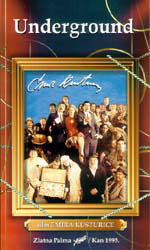

France
France
Yugoslavia
Yugoslavia
Yugoslavia (VHS)
Serbia & Montenegro (DVD)
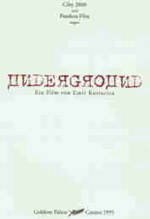



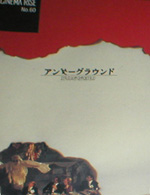

Germany
Germany (VHS)
Germany (DVD)
United-States
Japan
Japan (DVD)
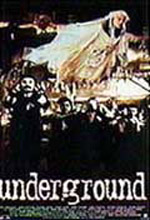
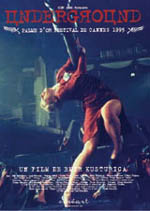


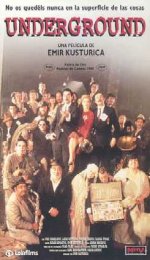
Italy
Belgium (DVD)
Slovenia (DVD)
Poland (DVD)
Spain